
Eddie Bracken just looks funny. It’s not in a physically distorted way; it has something to do with the innocent, cherubic quality of his face that makes you smile. And when he starts moving? You start to laugh.
Playing it straight: The Lady Eve
I foolishly put a poll on Facebook asking people what movie they felt was Preston Sturges’ best. It was foolish because I used the word “best” when I should have used “favourite” or some other word. How can you pick a “best” Sturges when there are a fistful of movies that could vie for the top with legitimacy? However … as it turns out, though a very small sampling, tied at the top of the results were Sullivan’s Travels and …
Continue reading
Easy Living (1937): Everybody fall down
When a an expensive fur coat falls on her head, Mary Smith’s life of scraping together enough for food and rent turns upside down. She suddenly finds herself in a world of wealth, as she’s mistakenly perceived of as the mistress of Wall Street banker and tycoon, J.B. Ball.
Easy living was never so hard — or muddled and funny.
Lily Damita, Roland Young and This is the Night
Without intending to, I caught This is the Night on TCM last night and I was delightfully surprised. It was funny, curious and also interesting historically in that it was the first full feature movie Cary Grant ever appeared in. It was directed by Frank Tuttle, a man I know best for having directed This Gun For Hire that starred Veronica Lake.
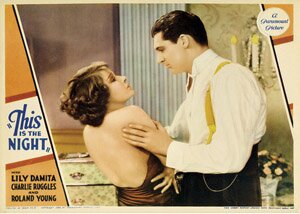 This is the Night (1932)
Directed by Frank Tuttle
To get the Cary Grant aspect out of the way, you can tell it’s an initial effort. His performance is good sporadically. Often he overplays it, though in one way it works because the film is a farce. You can see, however, the beginnings of what he would later become, especially his comedic skills.
But this movie is really Lily Damita’s and Roland Young’s. (The movie also stars Charles Ruggles and Thelma Todd.)
An athlete (Grant) returns from the Olympics. While he was away, his wife (Todd) has been involved with another man. As that other man, Roland Young must try to cover up the affair. With the help of a friend, Ruggles, he hires a heavily accented actress (Damita) to pretend she’s his wife.
It’s a relationship comedy – quite a funny one – and it is filled with sexual jokes. (The movie was made pre-Code.) For example, a recurring joke in the movie involves Todd whose dress keeps getting removed accidently by the chauffeur/butler. There are verbal jokes as well, such as Damita’s character who doesn’t understand English well, and ends up interpreting hints as, “I live in sin. I am naughty,” when Young tries to tell her to say she’s from Cincinnati.
It’s silly, yes, but lots of fun. It’s not exactly a screwball comedy; it’s a bit too farcical for that. But you can see the beginnings of screwball (just as you can see lingering hints of the silent era in the visual humour, as mentioned in this review).

What I found curious, and a little off-putting, was what I initially thought was a technical mistake in the broadcast but later saw was deliberate. It was this: much of the film occurs in Venice and much of that is at night. Every time the action occurs outside, at night, the screen goes blue.
Yes, it’s a colour that suggests night but in a movie that is otherwise black and white it’s a jarring and unnecessary effect. A quick online look revealed no reference to this so I don’t know if this was something the original movie tried or was added later. But I do know I would remove the effect.
Apart from that, This is the Night is a very fun and funny movie; it even has some nice romantic elements, not to mention Cary Grant’s movie debut. I was glad I found it.
As an aside, Cary Grant would work with Roland Young again a few years later in the movie Topper (1937).
As another aside, Lily Damita was married to Errol Flynn for a number of years and later married to Michael Curtiz. Her Hollywood career was relatively brief. She essentially got out of acting in movies when she married Flynn.
20 Movies: Topper (1937)
This was a movie I knew absolutely nothing about when I picked it up. I watched it and found it was one of the funniest movies I had seen in ages. This surprised me because of its age. There are a lot of movies that amuse me but not many that actually make me laugh.
Comedy, of course, is a pretty subjective thing and what I find funny may not be shared by someone else. Still, it’s hard for me to imagine someone not laughing when they see Roland Young comes down those hotel stairs with ghostly assistance.
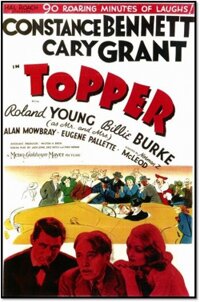 Topper (1937)
directed by Norman Z. McLeod
Fun, light and funny, the movie Topper is a delightful screwball comedy. It shares the style of, and comes a year or two after, the classic My Man Godfrey. Though not as good as that film, it excels in many ways, not the least of which is a very good cast.
While Cary Grant is in it (and playing an earlier version of a comedic type he would use later in His Girl Friday -– a self-involved man with the proverbial “heart of gold”), the real star is Constance Bennett.
The female lead in screwball comedies, like Carole Lombard in My Man Godfrey, is usually wealthy and ditzy (though not unintelligent). She’s generally completely unconcerned with everything around her except for whatever her wandering imagination has focused on. In the case of Topper, Bennett plays this role though it’s complemented by Grant, as her husband, who is equally wealthy and ditzy.
In contrast to this, there is always the serious role – in this case Corso Topper, played by Roland Young. He’s a banker – dull, pining for a more exciting life, and under his wife’s thumb (played by Billie Burke – Glinda, the Good Witch of the North in The Wizard of Oz).
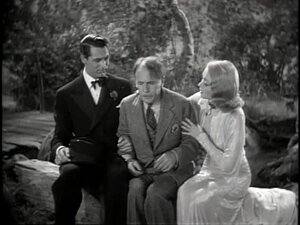 It’s a traditional contrast – trickster characters (Bennett, Grant) and the dull oaf that needs to lighten up (a bit like Malvolio in Twelfth Night).
The conceit behind Topper is that the wealthy couple George and Marion Kirby are killed in a car accident (caused by Grant’s fun-loving foolishness). They become ghosts. As such, they determine they are stuck on earth, unable to move on to Heaven, until they have done a good deed. They decide Topper will be their good deed. They will take him out of his formal, proper shell and introduce him to life.
And so the fun begins.
There are a lot of wonderful moments in the film, including numerous sexually suggestive jokes that would likely not be allowed in later years. They are not overt, brazen moments (as you would likely get today), but deliciously suggestive – making them funnier and more sexy. Bennett plays her role with delightful coyness and flirtatiousness. The interaction with Roland Young as the hide-bound banker is great fun to watch.
(It’s a bit surprising some of this got past the Hays Code.)
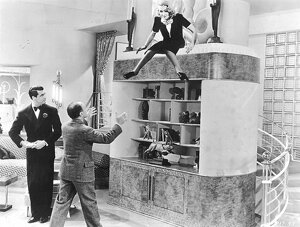 In Topper, you get to see Corso Topper come out of his shell and develop into the man he wants to be. (One of the best scenes, howlingly funny, is a drunk Topper being helped down stairs through a hotel lobby by invisible ghosts.)
You also see his wife develop from icy social climber to a more loving woman.
Screwball comedies are one of my favourite kinds of movies and Topper is a wonderful example of the genre. Recommended.
See: 20 Movies — The List
This cockeyed caravan: Preston Sturges defends fluff
I watched Sullivan’s Travels (1941) yet again last night because, as the main character John L. Lloyd ‘Sully’ Sullivan (Joel McCrea) says:
“There’s a lot to be said for making people laugh. Did you know that’s all some people have? It isn’t much, but it’s better than nothing in this cockeyed caravan.”
The words, of course, are from Preston Sturges, writer and director of the movie. This movie is, for me, the best of Sturges — though it’s really hard to say one is better than another when you consider movies like The Lady Eve, The Miracle at Morgan’s Creek and others.
If you’ve ever seen the Coen Brothers’ O Brother, Where Art Thou? you may be interested in knowing Sullivan’s Travels is where that title came from. It’s the movie Sullivan, a Hollywood director of light, comedic fluff, a man with a well-to-do, somewhat privileged background, wants to make. It’s to be a serious movie about how tough and awful this life is with, “…Bodies piling up in the street.” It’s to be, “A true canvas of the suffering of humanity!”
As his producers point out, what would he know about it? Realizing the truth in what they say, he sets off to find out, decked out like a tramp (from the wardrobe department) and with only ten cents in his pocket.
Unfortunately for Sullivan, despite his best efforts he keeps ending up in Hollywood.
In the third act, however, when he has finally given up his quest, that’s when he actually stumbles into the “trouble” he’s been trying to discover.
A plot summary does little to communicate why this movie is so good.
To begin with, it’s incredibly funny with the humour finding two sources: visual (slapstick) and verbal (witty dialogue). For slapstick, see the chase scene with the kid driving the rigged up “go-cart.” For dialogue, see the scene near the beginning where Sullivan argues for his idea with the producers (“But with a little sex!”).
While very funny (and a romance to boot, with Veronica Lake), it’s a satire of movie makers, particularly of the Hollywood variety. Some even argue that Sullivan’s Travels is the best movie ever about making movies. I think, however, Sturges’ satire goes beyond movies to culture overall.
His complaint is that comedy, and fluff generally, gets dismissed because, being light and agreeable when well done, it isn’t serious, or what we consider to be serious. A history of comedy at the Oscars gives credence to his complaint. It’s ignored when it comes to the “serious” categories like Best Picture.
I think his argument is two-fold: 1) audiences, on the whole, prefer lighter films — comedy, action, etc., and 2) the people who make the serious ones about such topics as homelessness, have no idea, no experience, no real understanding of what they are making a movie about. For one thing, the very people those films are sympathetic to, and that they stand morally side by side with, are the very people they show disrespect to by dismissing the kinds of films they like.
There’s a fabulous speech prior to Sullivan heading out to “learn something about trouble,” meaning homelessness. It’s made by Robert Greig as Sullivan’s butler Burroughs. He says he doesn’t think the plan is a good one because Sullivan has no clue about what poverty is: it’s not some romantic condition to be discovered but something virulent to be avoided. I think this is Sturges saying there is often a patronizing, even parasitic element to serious films and the subjects they treat. That’s probably far too extreme a view, but I think there is an element of truth in it. It makes for an interesting question though: can something not truly lived, something only experienced in a kind of vacation mode, meaning briefly, truly be understood? How often do we bring our assumptions about what something is, assumptions that come from a very different perspective, into our assessments and treatments, such as a in a film?
Of course, the movie doesn’t come across as pontificating, as the above makes it sound. It’s great fun, incredibly funny and with a beautiful Veronica Lake, romantic too. And even if the overall sentiment and the closing lines sound a bit cornball to us, I think it’s a legitimate view and never more passionately expressed as in Sullivan’s Travels.
I’ll have to watch the Coen’s O Brother, Where Art Thou? again because I’m now wondering if they were not only agreeing with Sturges and his argument in comedy’s favour but doing so by making Sullivan’s intended movie, one about a serious subject as done by a patronizing, uninformed fool? My guess is yes.
What Topper meant to Cary Grant
Although the movie Topper, despite it’s summer success in 1937, could hardly be considered a big movie, not in the Hollywood terms we usually speak of, it was a key movie in the career of Cary Grant (and for those people who came to love the movies of Cary Grant) because of what it did.
It was one of the first movies Grant made after he chose to break free of the feudal studio system of Hollywood, which basically dictated what he would appear in and what roles he would have, and became an independent actor.
It was also his first chance to do what he desperately wanted to do: comedy. It was the first chance he had to be something other than a pretty boy in a tuxedo and actually showcase his broader talents. It may also have been one of the first times, if not the first, he worked with a director (Norman McLeod) who used something akin to storyboards. McLeod would show Grant and co-star Constance Bennett sketches to illustrate body position, movements and facial expressions in order to better get across what he was after.
A few years ago I wrote a review of Topper but at that time was unaware of its place in Cary Grant’s personal career history. If I were writing it now, I’m sure it would read considerably differently. But I think the overall assessment would be the same. It goes:
Fun, light and funny, the movie Topper is a delightful screwball comedy. It shares the style of, and comes a year or two after, the classic My Man Godfrey. Though not as good as that film, it excels in many ways, not the least of which is a very good cast … (read more)