
Edward G. Robinson was one helluva a good actor. He even makes this exercise in the absurd and perfunctory a crime drama you can watch, even enjoy at moments. Often found in film noir collections, it isn’t noir. In a way, it’s screwball comedy without the humour.
Predator and prey and packs in Collateral
This movie is filled with fascinating imagery as Michael Mann presents a nocturnal vision of the city that is dark and threatening. It also has a key image, the coyote, that I think many people misremember. If you look at it closely, it’s not quite the image you think you saw and its meaning is very different when you really see what Michael Mann show us.
Hypocritical and disturbing: They Won’t Forget
I’m usually more forgiving of the sins of older movies as I try to keep in mind the periods they were made and the attitudes and mindsets of the day. But the subject They Won’t Forget takes on and how it deals with it makes it ineligible for any license because of when it was made. This is probably the most disturbing movie I’ve seen in quite a while.
High Sierra: When the bad guy is the good guy
I recently finished reading Stefan Kanfer’s Tough Without a Gun: The Life and Extraordinary Afterlife of Humphrey Bogart. (The title is from something Raymond Chandler said of Bogart.) So of course, I’m back to watching Bogart movies, at least for the time being.
The accidental film noir: I Wake Up Screaming
It’s Day 2 of For the Love of Film (Noir) — don’t forget to (or use the button on the right). Today I have a quickly scribbled, un-proofed, un-thought through look at the movie I watched last night. The studio considered calling it Hot Spot but, according to the DVD I have, the actors insisted on them using the original name, which is …
I Wake Up Screaming (1941)
Directed by H. Bruce Humberstone
As I watched I Wake Up Screaming last night I had two thoughts running concurrently. First, this should not be a good movie. Second, somehow it manages to be a good movie. How does that happen?
I’m not sure. I think it lies partly in Betty Grable, whose performance is a level above the other main actors in the movie.
It’s also in the characterization of Ed Cornell, played by Laird Cregar, who seems a cross between Vincent Price (in the slightly effeminate voice and its cadence) and possibly a low rent version of George Sand. (I mean vocally, nothing else, and not much there either. But there seems to be something vaguely Sand-ish in the voice.)
Cregar’s Cornell is creepy, to say the least, and that makes the movie compelling. Though the film’s mystery may be obvious, it doesn’t matter. The creepiness keeps us fascinated in a “slowing down to view the accident” kind of way. Cregar’s character isn’t the only one that gives us the willies.
Elisha Cook Jr.’s Harry is equally troubling. Soft-spoken and gentle, his focus and attentiveness to Grable’s Jill Lynn leaves us feeling something isn’t right about him. He’s stalker material.
Much of what makes the movie watchable is in the script. The bad guys in this movie – and there are a lot of them – are not villains so much in the commitment of crimes regard, as in their psychology. In fact, most of them have stalker-like personalities or variants of it.
They are all focused in some way on Vicky Lynn, played by Carole Landis. They want to either possess her, use her, or both. And she, being ambitious, is happy to permit it as she uses them. Thus, in a sense, she invites what follows from it.
Into this morass of twisted personalities come Victor Mature as Frankie, a kind of nice if goofy sports promoter (who find himself accused of murder) and Vicky’s sister, Grable’s Jill Lynn.
Frankie and Jill are the normal ones (for lack of a better word) and also the ones who suffer the consequences of a world populated by twisted personalities.
Visually, the movie delivers the noir goods but that may be less an aesthetic decision as a kneejerk response to making a crime movie in the forties. Crime equals scenes of darkness and shadow, ergo scenes of darkness and shadow. I get the sense director H. Bruce Humberstone was a paint-by-numbers kind of director, though that may be unfair to him. But that is how it strikes me.
Still, by accident or design, the movie looks good as a noir. It has a low budget feel and some very nice shots, especially near the end where we see Mature looking down at Harry snoozing at the front desk.
Overall, then, I Wake Up Screaming strikes me as an accidental noir. It discovers a noir world in the script it brings to the screen and in the kind of kneejerk response of how it visually portrays that script.
Much of what happens on screen is highly melodramatic and it would be too much were it not for the material driving it, Laird’s unsettling Cornell, and Grable’s much better anchored performance as Jill. Victor Mature looks great as a noir character, especially in the interrogation scenes, but he is often well over-the-top. Also, for about two thirds of the movie, once outside the interrogation room (and often within it) he plays a goofy kind of guy without a care in the world. It’s deliberate, in part, as it’s an aspect of the character. But it just seems too much.
And having gone on with all these negative comments about the movie, I still have to say I liked it quite a bit. However, it feels to me it’s a good movie through dumb luck; a film noir by accident.
For the Love of Film (Noir): This Gun For Hire
Today the For the Love of Film (Noir) blogathon begins and I decided rather than burble about the genre, which can be as murky as the streets and lives its films tend to articulate, I’d post something about a specific noir, one that stars an actor who really hit his stride, as far as fame goes, with the genre and this particular movie, This Gun For Hire. The actor, of course, is Alan Ladd.
The blogathon runs thru to February 21st with the goal of raising money to restore a specific movie, The Sound of Fury (1950, aka Try and Get Me). I love the brief description on IMDb, “A man down on his luck falls in with a criminal. After a senseless murder, the two are lynched.” If you’re inclined to pitch in, please do. You can . And now, on with …
This Gun For Hire (1942)
Directed by Frank Tuttle
I came upon a review of This Gun For Hire that complained about it being viewed as film noir. The reviewer argued it was not; it was pulp. The first thing I thought was, “Aren’t all the best film noirs pulp?” My second thought was a sigh because film noir is so idiosyncratic in its definition. Everyone has their own idea of what it is.
For me, this movie is film noir. Regardless of whether it is or not, the important thing is it’s a wholly captivating movie, thanks largely to Alan Ladd’s portrayal of Raven.
Of course there is also some pretty brisk direction from Frank Tuttle and a good script.
Billing aside, this is Alan Ladd’s movie. He is the star. As good as they are, you could replace Robert Preston and Veronica Lake and not much would change. Replace Ladd and I suspect you would have a different movie and perhaps not as good.
Amid the murder and mayhem of the film, it is the story of Raven: what he does and why he does it. In other words, it’s about who he is. In the first few minutes, we see a man who uses a gun and, given the title, we infer it is for nothing good.
But we quickly see him with a cat and a moment of softening. He cares for the cat; there is tenderness. Raven then leaves the room and almost immediately we see a woman come in to tidy it. She shoos the cat away crossly and Raven steps back into the room.
Now we see what the gun is about. We see the Raven the world must deal with. He strikes the woman, tears her dress and forces her out of the room.
It is less what he does than it is how he does it: quick, brutal and unrepentant. The tenderness he has for cats is not extended to people. The opening, then, tells us what we need to know about the character. From here, the story’s engine kicks in. The opening is a great example of exposition. It provides essential information, and in a riveting way, so we can understand what is to follow.
What follows is standard pulp/film noir material. Raven is a hired killer. He does a job. Then he is shafted by the man who hired him. He’s paid with marked, stolen money. As soon as he spends some of it, the police are after him and he immediately recognizes what has happened. Now his goal is simple: kill the people who set him up. And he is nothing if not focused.
It is not that simple, however. There are complications. But this is the essential story: Raven on a mission to kill the people who set him up and how his character is revealed and alters in the process. Even the ostensible stars, Preston and Lake, are secondary to Ladd’s Raven. They are tools for revealing his character.
As with the similar (though not nearly as good) movie, Lucky Jordan, the complications involve the Second World War, selling vital material to the enemy, and patriotic pleas. Raven cares only for himself (as does Jordan) and it’s the role of Lake to persuade him to see the larger picture and care for the country which means other people.
What she is up against is a man whose background was as brutal as he has become and that has defined him and how he sees the world. The world he now inhabits confirms his view. Yet we know there is something human in him from how he relates to cats and we understand later in the film why he is as he is in a scene where he describes his childhood. Despite his callousness and violence, we care about him.
Although he was in countless movies prior to this one, This Gun For Hire was the first time Alan Ladd starred in a movie, although he was sitting in the back row as far as the billing went. I can understand why he hadn’t been noticed prior to this though. From the few movies I’ve seen him in, Ladd seems one of the quietest, most understated actors I’ve seen. Few actors express anger and melancholy as well as he does or as naturally.
Frank Tuttle, a kind of journeyman director who cranked out movies for the studio, excels here, perhaps because of the script, perhaps because of the work of cinematographer John F. Seitz, or maybe because he was a meat and potatoes director. The movie is simply and quickly directed and that is one of its virtues.
Call it a crime film, call it pulp, call it what you will, to me this is a great example of noir and regardless of genre a thoroughly compelling movie. As you may have guessed, I liked it a lot.
L.A. Confidential: moral dilemmas and style
Recently, it appears I’ve been on a John Wayne thing. To get away from that for the moment, here’s what I wrote recently about L.A. Confidential (1997). For what it’s worth …
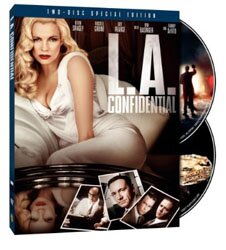 I’ve always been lukewarm on noir films. I prefer comedies, romances and, of course, westerns. Still there are, as we all know, some exquisite noir films (Gilda, The Big Heat, The Maltese Falcon and so on.) And really, if a movie is good, who cares about the genre?
I start with that small preface because L.A. Confidential is a noir film and, if I recall correctly, it was hyped that way back when it was released, and hyped in such a way (read “excess”) that back then I watched it with reluctance. (Back then, by the way, would be 1997.) I thought, “Oh great. Another movie that’s all about evoking an older style and achieves cleverness by how closely it accomplishes this.”
Put another way, I was expecting a lot of style and very little substance. I expected it to be visually great but with a tedious, predictable story that mimicked the structure of older films.
In some ways, that’s what L. A. Confidential does. What I had forgotten about with good noir movies is that, much like westerns, the story focuses on a moral question. The approach here, however, is quite different than in a western.
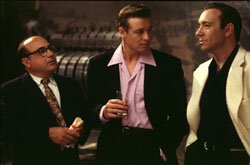 For me, a moral centre is what makes a movie compelling (assuming that the technical bits are all working at a relatively high level).
In L.A. Confidential, there are loads of moral choices. Although most of the characters have moral dilemmas, the story focuses on the characters played by Russell Crowe, Guy Pierce and Kevin Stacey. They are very different characters but they all make choices. Put simplistically, each chooses whether he’ll be a good guy or a bad guy.
It’s because the story, fairly complex, unfolds with a certain irrevocable determination that all the heavy lifting as far as costumes, sets, music and so on, elements to evoke a period, style, a kind of cinema, work. Often something period is a work of self-indulgent crap. In this case, the story demands the period look and feel and there is no sense that the filmmakers were treating themselves ahead of the audience.
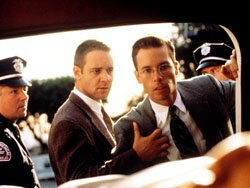 The end result is a very good movie, regardless of the genre, one that’s engaging and rewarding.
I’m sure I’ve said this before but, to repeat, I’m not a film expert, a film historian, a student of the cinema. I think I watch movies the way most people do. I’m dazzled sometimes by editing, effects, cinematography, but in the end, budgets be damned: it’s a well told story I respond to.
L.A. Confidential is a well told story. As a bonus, it’s visually brilliant.
3½ stars out of 4.
Dirty Harry: should I like it as much as I do?
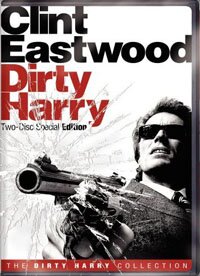 I’ve always found Dirty Harry a troubling movie. Well, almost all of the earlier, image making movies of Clint Eastwood have been troubling to me, but Dirty Harry tops my list. The reason is simple: from the first time I saw it, I’ve loved the movie but I felt that I shouldn’t.
The conflict is easy to explain. The movie is manipulated to have you cheering for Harry so when, as in a western, the final showdown happens, there’s a cathartic moment, like scoring the winning touchdown on the last play of the game. But then you do a kind of mental double take: this guy with the big gun is actually ignoring the law, being as bad as the bad guys, and feeling justified about it because, well, they’re bad guys and he’s fighting for the good guys.
Harry is essentially a vigilante and in the movie, by creating a perverted, killing bad guy (“Scorpio”), you inevitably root for him because the emotion carries you along and your thinking side is turned off, in a manner of speaking. In his review, Roger Ebert argues that it’s essentially a fascist film, and this may be true, although I think the final scene with Harry tossing his badge in the water could be construed as meaning he’s outside the law now, no different than the criminals he’s been hunting down. It may be the movie wants you to cheer for Harry so it can then say, “Now think seriously about what you’re really cheering for.”
There are lots of people who write about Harry’s appeal to the conservative right, at least of the time (1971), and a frustration with liberal approaches to crime – respecting individual rights, in this case the criminal’s, and abandoning victims. And this may be true, too, though it should be pointed out that operating beyond the law, ignoring victims, is not something to be found on the far right of things. Some, at the far left, have had no qualms about victims when they’ve initiated a violent act for their cause. It’s an attitude that occurs at the far end of things, at extremes, be they left or right.
But what about the movie? Dirty Harry always initiates discussion about the politics of the film and often the movie itself gets overlooked.
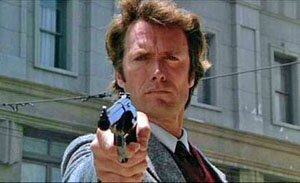 First off, I see it as an urban western, and loving westerns that may explain why I like it so much. Harry’s a loner, operating on his own (often to the exasperation of his superiors). He gets little help – some, but not a lot – and he’s after a really bad guy. So it’s framed like a moral tale, the way westerns are … but this leads us into the politics again. It is a moral tale but one a lot more subtle and ambiguous than the usual western because the good guy, well, there’s a reason they call Harry “Dirty.” (This comes up several times in the film, the question of why he’s “Dirty” Harry, with a number of possible reasons thrown out. I think that final scene with the badge is the film’s only suggestion of the real answer.)
Another aspect I like about the movie is how very, very seventies it looks. Of course there are the clothes, the hair, the cars … but I think even more so it’s the overall look of the film. With that look, today it would be called an indie film. Despite some restoration, it still feels gritty and grainy, even when it isn’t. Not only does the movie not look slick, it almost looks anti-slick, as if it’s trying to disassociate itself from Hollywood – a characteristic of a number of movies from that period, like Taxi Driver, for instance.
I was also struck by a nice difference between Dirty Harry and its progeny, more contemporary movies with heroes and really bad villains. Today, a character like Harry would be up against an almost superhuman bad guy. But in this movie, the character of Scorpio, while very bad, is almost something of a screw up. I’m thinking of one scene where he’s out to shoot another victim but gets spotted by the police in their helicopter. Scorpio is bad, he’s dangerous, he’s sick, but he’s not a brilliant criminal mind. He’s not nearly as clever as he would like to imagine himself, and nowhere near as clever as a character such as him would be in a contemporary movie. In other words, there’s a bit more realism to Harry and his bad guy. (And realism is one of the things movies of that period aspired to.)
Finally, I believe one of the reasons this movie is so satisfying is because it understands so well set up and payoff. Like the way good jokes work, with their structure and their rhythm, there are a number of scenes in Dirty Harry that deliver the same way (for example, the “Do you feel lucky, punk?” scenes).
An interesting comparison between Dirty Harry an one of its progeny is the recent revenge film, Man on Fire, with Denzel Washington in the lead role. Whereas in Harry, directing and cinematography are almost self-effacing, with most of the emphasis on story and performance, Man on Fire is very self-consciously directed and very obvious in its cinematography, almost the exact opposite of the Don Seigal film. And whereas Harry is consumed with his hatred for bad guys and indifferent to what he does to nail them (with the possible exception of the end with the badge), Denzel’s character in Man on Fire is almost morose with awareness of being lost to the dark side and, when he goes after the bad guys, is almost like a suicide bomber, willing to do whatever needs to be done and sacrificing himself willingly as a kind of redemption. (And Denzel’s bad guy is much more clever than the Scorpio killer.)
Despite being a film from 1971 and looking very much so, Dirty Harry still works and works brilliantly. It’s just a troubling with its ambiguous politics, and just as thrilling with its cop chasing a killer suspense. I loved it.
(Note: For some of Clint Eastwood’s views on Dirty Harry, have a look at the 1974 Playboy interview, Eastwood Talks Dirty Harry. Amongst other things, when the badge scene from the movie comes up and the reference to a similar scene in High Noon, Eastwood disagees with the comparison saying High Plains Drifter is much more along the lines of the Gary Cooper film.)